It’s time to gear up for “Back to the Beginning,” Black Sabbath’s final concert planned for July 5th, 2025. Whether it was in the spirit of experimentation, or a desire to make each song distinct, Tony Iommi covered a lot of ground with each Black Sabbath record. This wasn’t just a case of setting up a few mics and running through the songs. With a mix of acoustic pieces and experimental passages for guitar, it’s clear the band’s vision was not just to be heavy, they wanted to take the listener on a journey. Join us as we walk through a brief history of Black Sabbath tone.
Don’t have AmpStamp yet? Download now and head to the Explore section to load the presets mentioned below!


Early Days: Copy of a Copy
In the late 60’s and early 70’s there weren’t that many options for guitar players when it came to tone. Marshall had borrowed from Fender and focused on improving the loudness of their amplifiers. Maestro debuted the Fuzz Tone in 1962, and once it became popular from a Rolling Stones hit single, many seized the opportunity to make their own version of fuzz. But if you didn’t like the sound of fuzz, guitarists had to turn it up to get the sound they were looking for–the concept of a master volume wouldn’t come until the mid 70’s. And when amps were turned up, they typically got flubby from too much bass, harsh from poorly designed power amps, or even broken due to speakers that couldn’t handle loud volumes for long periods of time.
Preset: Paranoid
Enter Paranoid, our take on the early sound of Black Sabbath. There is some photographic evidence of Iommi during the recording of Paranoid with a white SG and Laney and Vox amps.1 While it’s unclear where the Vox was used, early Laney amps were essentially copies of the first Marshall circuits, similar to the JTM45, if not the original Fender version which allegedly came from an RCA manual. These early designs were heavy in bass frequencies which created a market for treble boosters. Marshall eventually added more treble and reduced bass with their High Treble channel, later referred to as Channel I. However before that, a popular effect like the EQ100 Treble Boost would find it’s way on to several classic recordings.
With only one guitar, Iommi tended to double his parts and hard pan them left and right. With “Paranoid,” in particular, it sounds like there were different mic placements for each take. The left channel sounds more towards the center of the speaker, providing a brighter sound, and the right channel sounds more towards the edge of the speaker, providing a darker sound. We’ve mapped one of the toggle switches on the Floor Controller for easy access, aptly titled “Bite.” We also couldn’t help but include the RM100 Ring Modulator, featured during the solo in “Paranoid.” Add the WH100 Wah for tracks like “Electric Funeral”, and we think this is a really great snapshot of this early period in Black Sabbath tone history. Fire up the tritone, and let it rip.
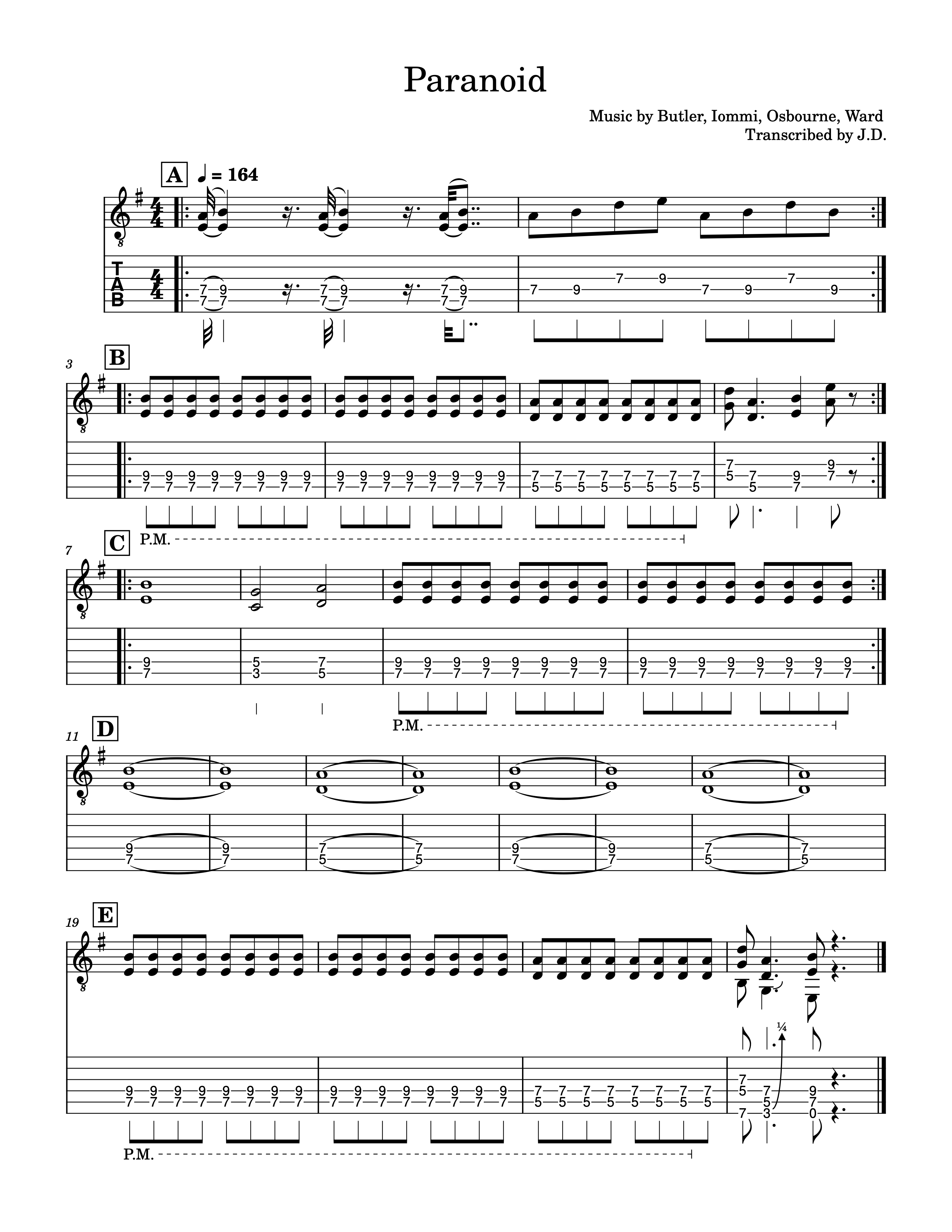
Playing Notes: Paranoid
Something that I found interesting when taking a closer look at these classics is that my phrasing didn’t always line up with what Iommi was actually playing. It’s subtle, but take a moment and pay attention to his rhythmic style. For instance, there is a pause at the end of measure 6 in section B during the verse where I almost always add additional content to fill the empty space. It took a lot of concentration to leave that gap and then come in on the repeat with a palm-muted E power chord. I was adding accents there too! One additional note, in measure 2 of section A, Iommi lifts his fingers after each note for a staccato feel. I had previously barred the D and G strings on fret 7 which does not sound the same.
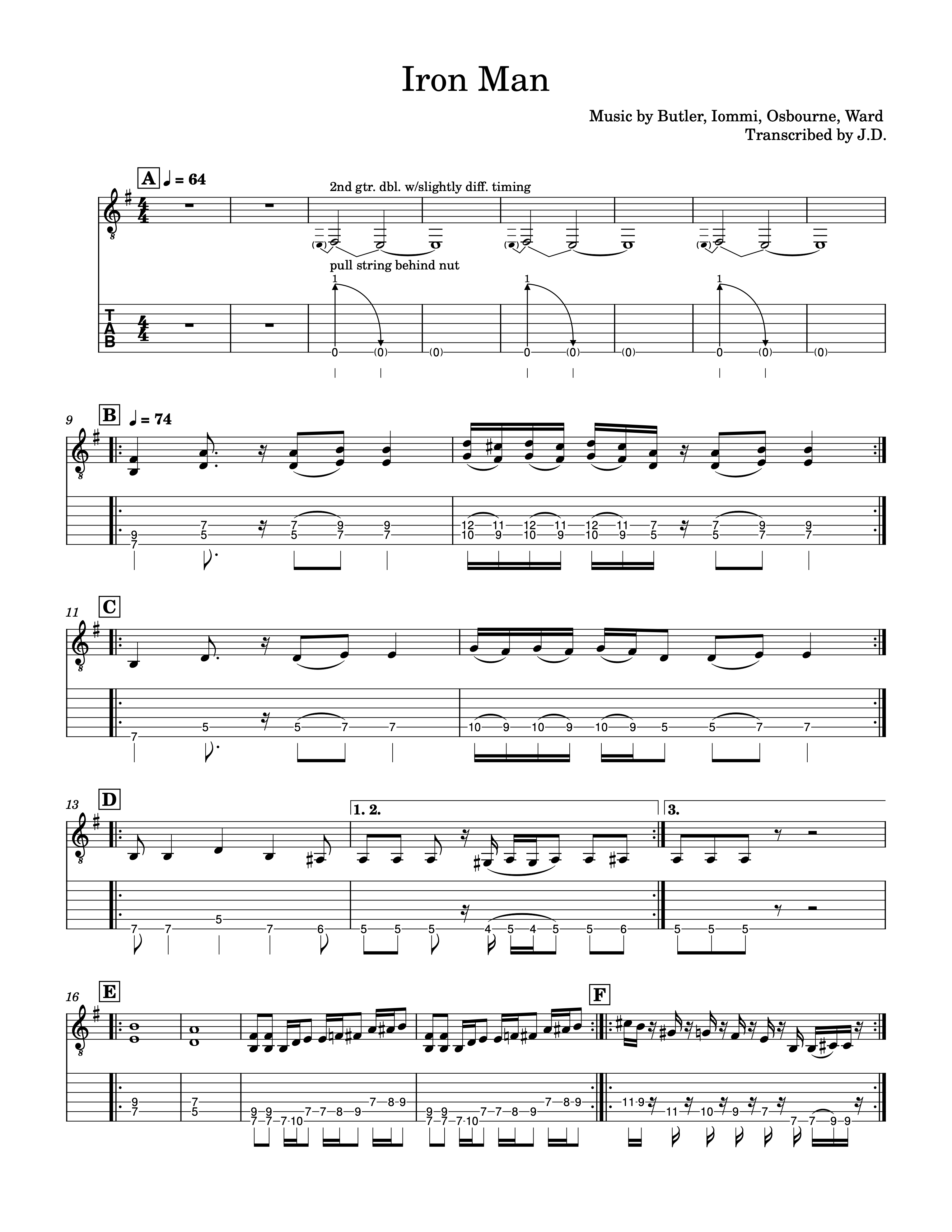
Playing Notes: Iron Man
The riff that launched a thousand bands! Made even more famous by cartoon deadbeats Beavis and Butthead. When looking more closely at this song, there is a lot of restraint in Iommi’s playing. And the rhythm of the main phrase is peculiar. I was not sliding from the D to E power chords, opting to add more stops than are present in the recording–I seem to have a heavier rhythmic strumming style. It’s definitely a challenge to try and match a recorded performance. You can learn something about your own way of playing by trying to mimic others.
Master of Reality: A Bigger, Heavier Sound
“It was part of an experiment: tuning down together for a bigger, heavier sound.” – Tony Iommi2
With their third album, Iommi made some drastic changes. In retrospect, this might have been a response to the new term being used to describe their music–heavy metal. The question being, could the music get any heavier? After experimenting, Iommi settled on tuning his guitar down to C#, and increasing the Bass level on his amplifier for added …heaviness.
Presets: SweetLeaf II, SweetLead II, Master of Reality
We’ve seen claims that a Laney Klipp 100W amplifier was used on Master of Reality. Let us know if you have a link to a source where Iommi states as much. While this amplifier is still on our list to explore, we had some success combining the FZ102B Fuzz and the EQ100 Treble Booster which is a more traditional approach for this tone given the information we have. We also fine tuned the cabinet selection for better results. There is definitely something heavy about this tone. It has a chunkiness that you can really dig into with palm-muted power chords …turn on, tune down, and feel the heavy.
Playing Notes: Sweet Leaf
Another heavy riff from the master. And another riff where I was adding more when there should be less. The biggest difference was in the first measure/section A. I found it extremely difficult to pause between the first transition from the A to D power chords. I tend to want to add something during that eight note rest. In fact, you can sometimes hear a pick scrape from Iommi just prior to the D power chord which sounds like it’s from an up stroke getting ready to hit the next chord. There’s also a slur at the end of section A that isn’t always in time as we’ve notated, feel free to experiment when playing along with the record.

Vol. 4: A Touch of Brightness
On the next album, things are brighter. Possibly as a reaction to tuning lower and increasing Bass to try and make things heavier. Ultimately, the final mixes sounded too dark, the impact may not have been as intended. With Vol. 4, we hear new JBL speakers, the fuzz is out, but the lower tuning remains. It’s like a return to the early days, with monster riffs–possibly one of the best in the catalog.
Preset: Vol. 4
This is a fairly straightforward tone, back to basics. The brightness inherent in the 2×12″ C 100W ’68 Cabinet shines through and helps rhythm guitars cut, especially with lowered tunings.
Playing Notes: Supernaut
While a simple song, consisting of only two riffs, it’s certainly one of my favorites. Apparently, it was a favorite of Frank Zappa’s too.3 Regardless, this song is all about slipping and sliding on the fret board. It sounds like section A is played with one finger, either the index, or middle. Try using only one finger and sliding into the D, then slurring down to B, and back up to D. The song really came into focus once I realized that, and it’s fun to play! Not to mention the monster chorus riff. Make sure to note the difference in the last chord in section B before the repeat. It’s subtle but it helps the transition to the 7th chord both harmonically and physically based on economy of movement. And one more thing, pay close attention to measure 6 in section A, there’s a slide back down to E at the beginning of the measure that’s really hard to catch.

Commercial Excess
Iommi admitted in his autobiography that as the band grew more successful, things became more difficult. There were difficulties keeping the band focused, an eventual lawsuit with management over mismanaged funds, and no shortage of party favors to keep everyone going. Nonetheless, this didn’t stop Iommi from trying to keep things interesting with each new record. With Sabbath Bloody Sabbath and Sabotage, we continue to see experimentation between bright and dark passages (an acoustic chorus in a heavy metal song!?), new synthesizer sounds, all against a steady foundation of heavy riffs.
Presets: Sabbra Cadabra, S.B.S., Sabotage
With the next few albums, we hear a more compressed tone, similar to Alnico speakers from a Vox AC30. Being there is evidence that Vox amplifiers were in the studio during some early sessions, we queued up the 2×12″ C 30W ’67 Cabinet, however still using a classic Marshall head similar to the Laneys Iommi was using. The sound was impressive enough to share.
Playing Notes: Sabbra Cadabra
Watch out! This riff moves fast. It’s in 12/8 time, similar to 4/4 with quarter notes having a triplet feel. This is another great example of Iommi slipping and sliding on the fret board with economy of motion helping to maintain a faster tempo. In section A measures 1-2, I found it easiest to slide from E to G with the middle finger leaving the index finger free to grab the high E. Note, the initial slide from E to G is a hammer-on, not picked!

Playing Notes: Hole In the Sky
Another monster riff in 12/8. While the whole song is excellent, the best part has to be the power chord bends in section B. They sound so sinister.

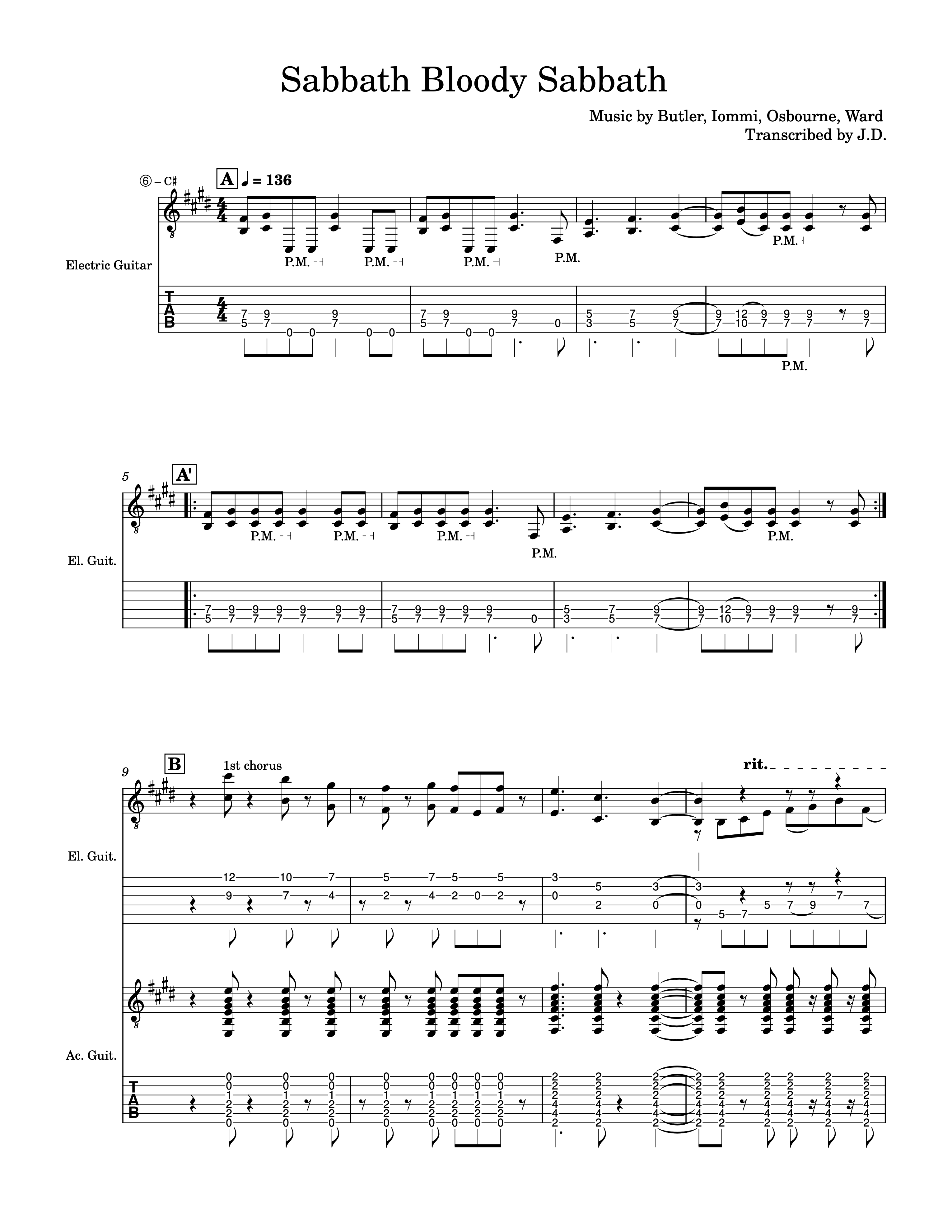
Playing Notes: Sabbath Bloody Sabbath
I saved “Sabbath Bloody Sabbath” for last. It’s one of Iommi’s magnum opuses that successfully combines softer elements that stand in contrast to the heavier parts. The transition to a gentle, acoustic chorus, then back to heavy electric guitar is extremely effective. This helps set the mood and especially strengthens the heaviness of the riff in section D. Note, I’ve transcribed embellishments from the first chorus only which are more or less similar to the second chorus, hopefully this helps provide a range to experiment with while playing along.


In today’s landscape, it goes without saying that heavy metal guitarists rely solely on preamp distortion, keeping master volumes low for tighter bass response, and use modern speakers like Vintage 30s for balanced tone. But imagine a world before all of this was in place. Heavy metal wasn’t a concept, just heavy music. The word heavy could apply to lyrics, tone, or image. Black Sabbath seemed to embody all three. Without a blueprint to follow, what else could heavy music have sounded like?
1 Grow, Kory. Liner Notes for Black Sabbath. Paranoid: Super Deluxe Edition. Warner Records Inc., 2016, p. 8.
2 Iommi, Tony, and T.J., Lammers. Iron Man: My Journey Through Heaven and Hell with Black Sabbath. Da Capo Press, 2011, p. 98.
3 Butler, Geezer. Into the Void: From Birth to Black Sabbath and Beyond. Deyst, 2023, p. 131.
 The Musicology Group