
SynthStamp 0.9
SynthStamp is a celebration of the history of electronic music, featuring fully modeled engines and familiar user interfaces behind some of the most influential synthesizers. Tap and drag to patch, save your patch as a preset, and export presets to share across all of your devices including Mac, iPhone, and iPad. Yes that’s right, iPhone. Take your sound anywhere.


- Stereo audio input for realtime effects processing
- Model 5001 based on the ARP 2600–finally on mobile
- Circuit-bendable model B500 based on the SK-1–we haven’t seen one either
Choose Your Adventure


5001 Analog Synthesizer: dynamically patchable, semi-modular, monophonic analog synthesizer from the late ’70s, with a stereo preamplifier. A real idea factory, from classic analog synth leads to creative sound design, this synth is a tool for exploration and experimentation. You’ll truly fall in love with the snappy, milky quality of the voltage-controlled filter. Frankenstein lives.
5001 Analog Synthesizer Field Guide
B500 Sampling Keyboard: circuit-bendable ROMpler from the mid ’80s, with 4-voice polyphony, multi-channel note memory, and a stereo sampler. Bend, sample, and compose melodies with this portable gem. Combine with continuous live sampling to create sounds that simply shouldn’t exist.
B500 Sampling Keyboard Field Guide
A Quick Look at the Different Components of SynthStamp
SynthStamp can be run as a standalone application or as an Audio Unit (AUv3) plugin inside supported DAWs, either as an Instrument with mono side chain input, or as a Music Effect on stereo/mono audio tracks for realtime processing, with full MIDI support. Presets can be imported and exported for easy sharing across devices. While on the same device, presets are stored in a common location across standalone and Audio Unit installations for shared access.
Stereo Audio Input
- Stereo
- Mono-to-Stereo
- Mono
SynthStamp supports stereo audio input. This will take on different forms depending on the synthesizer, refer to synthesizer detail pages for specifics. Placement as a stereo Audio Unit starts with stereo passthrough behavior. Note that “passthrough” includes distortion and signal degradation from preamplification, internal sampling rates, and speaker emulations. Next, explore routing options and/or check out some of the factory presets to enable a variety of stereo and mono effects.
When running as a mono plugin, left and right channels will be summed where necessary at the input and output.
Multi-Faceted Toolbar

At the top you’ll find options for Settings, System Controls (Volume, MIDI Mapping), Preset selection, Audio Input selection, and options to explore curated presets, as well as Import/Export presets for sharing between devices and with others.
Folder-Based Preset System

Within the Preset selector dropdown you’ll find options to create a new preset, save and overwrite the currently selected preset, copy the selected preset to a new preset—including any unsaved changes, or create a new folder. Tap any row to edit the name and/or folder of a preset. Tap the pencil icon in the title bar to edit the folder name and/or parent of the current folder. All options are also made available in the app’s File/Edit menus.
Programmable MIDI Control
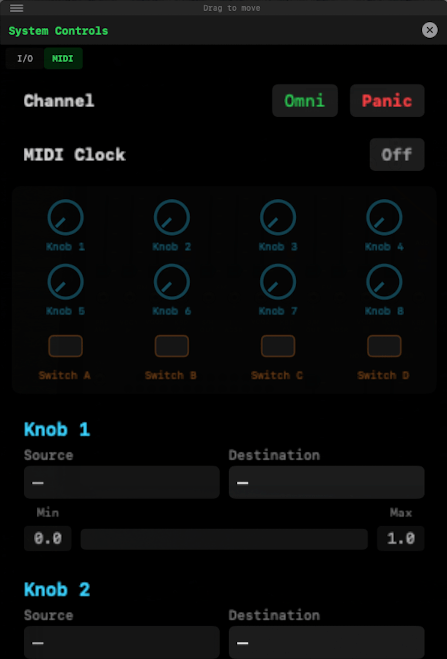
Route destinations for up to eight knobs and four switches to any control on a synth. MIDI settings are saved per preset. The control panel is fully functional and can double as a live interface for focused manipulation. Select a MIDI source for each control to allow input from an external device. Customize parameter range min/max to limit adjustment.
Zoomable Mobile Interface

On mobile devices with smaller displays, use the zoom slider to increase focus on controls or the keyboard. Drag and scroll to patch with two thumbs, similar to video game mechanics.
Features
- Universal App available on Mac, iPad & iPhone
- Run as Standalone or Audio Unit (AUv3) App Extension
- Stereo Audio Input/Output
- MIDI Support
- DAW Clock/Tempo Sync
- Folder-Based Preset System
- Preset Import/Export
- Zoomable Mobile Interface
- NEW MIDI Clock Support
Stay Tuned for New Gear
We’ve launched release 0.9 to get these synths out there and in your ears. We’re seeking some early feedback and will be rolling out an official 1.0 release shortly. This will include additional features like sequencing and, of course, more synths. Let us know what you think and what you want to see next!