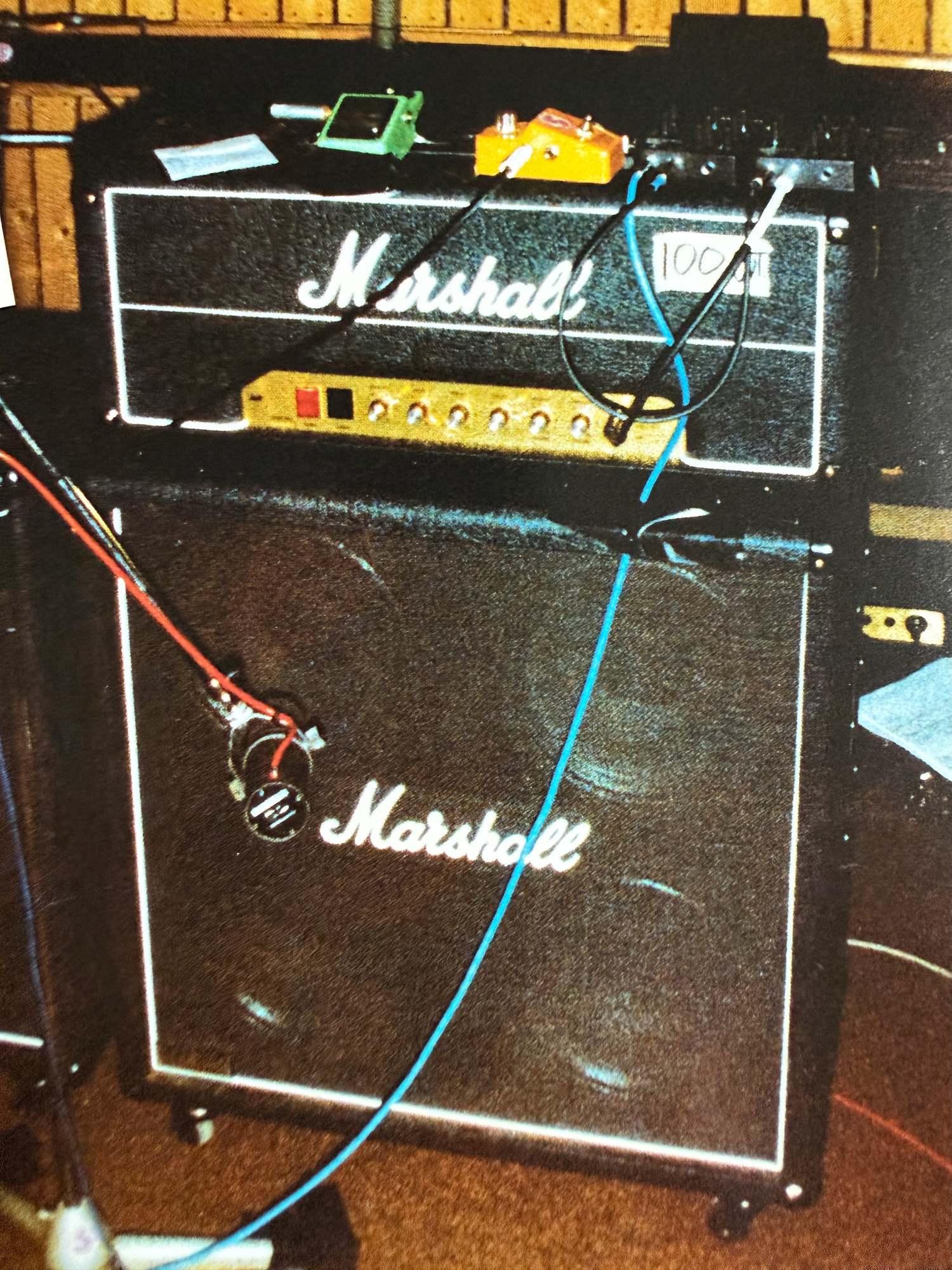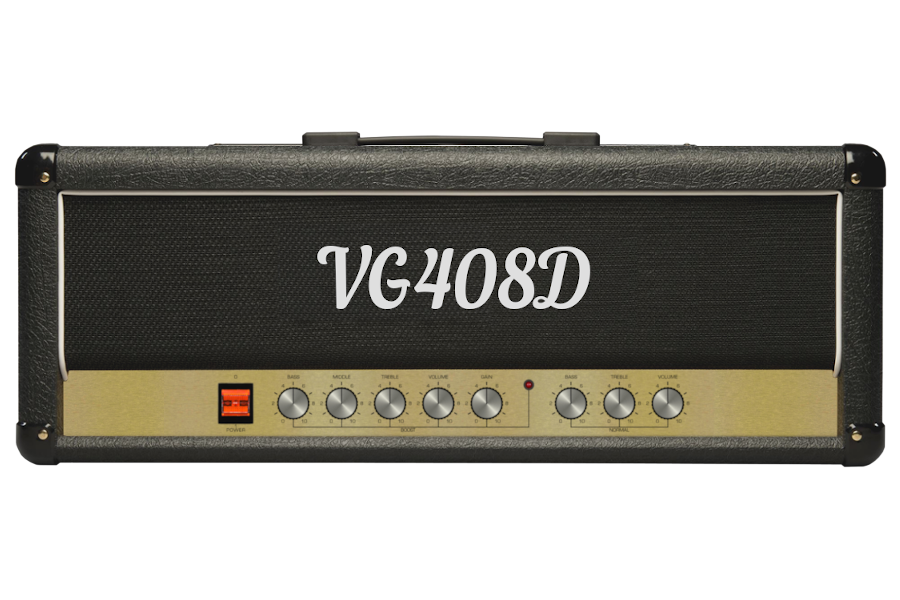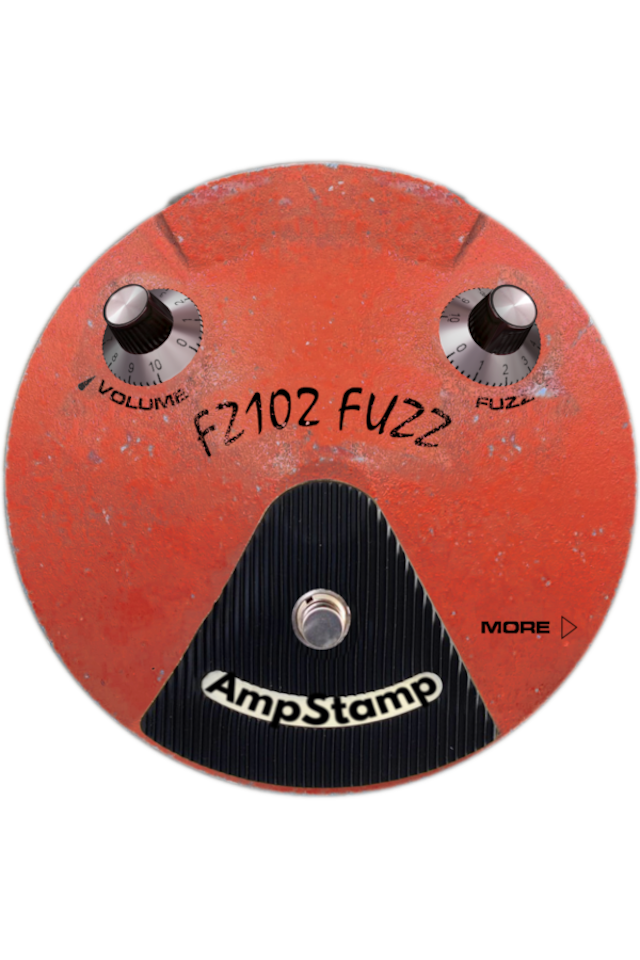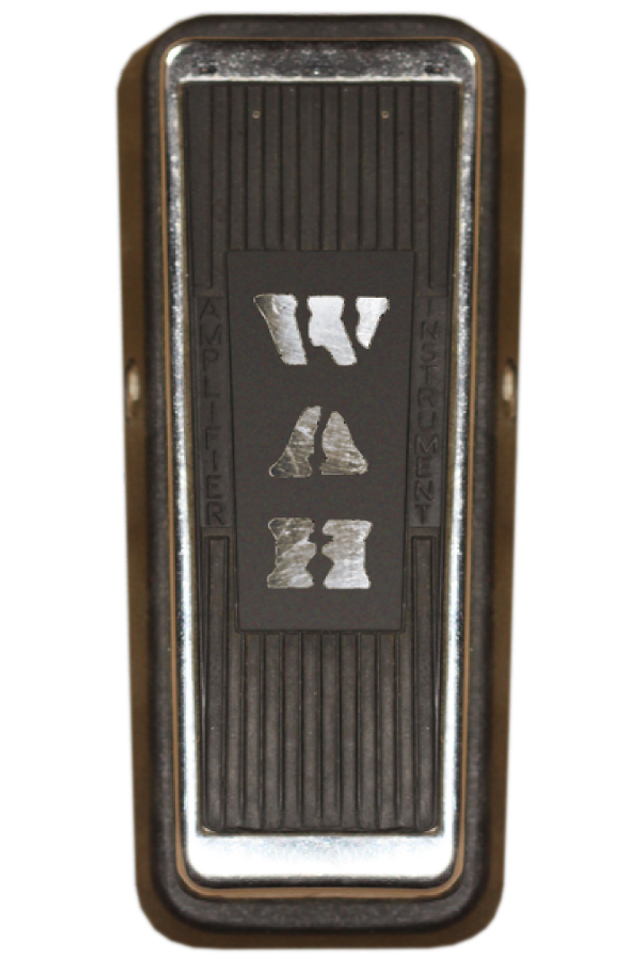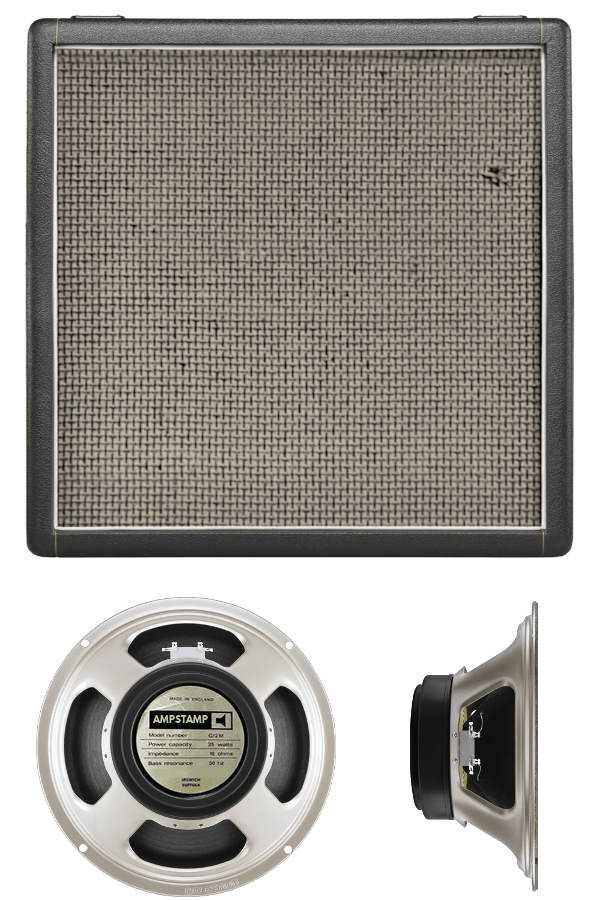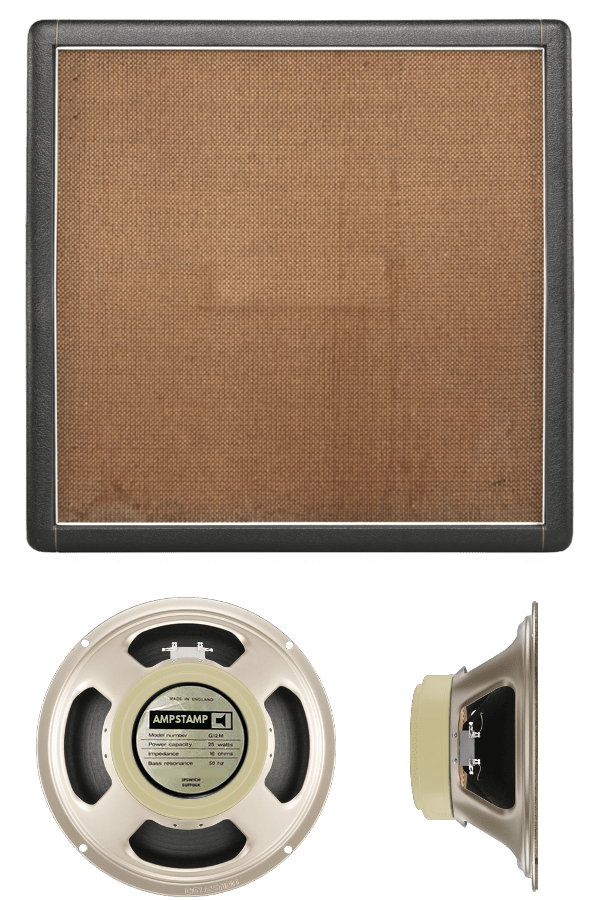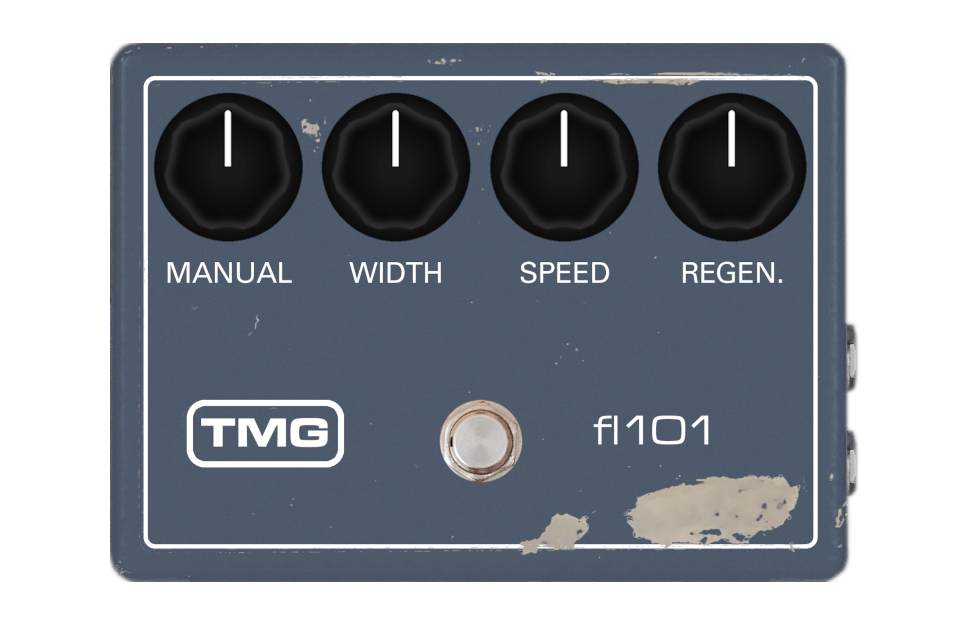
Re-re-re-re-re-re-visited. Needless to say, we’ve been after this sound for some time now. It’s one of the first tones we debuted with, and this is now the sixth iteration in our quest. We’ve got something new to share, take a listen.
Download AmpStamp now from the App Store and tap the Explore button to load curated presets like Woodstock VI.
First Rays of the New Rising Cabinet Drive
With the release of AmpStamp 1.10, we introduced Cabinet Drive, meant to simulate speaker distortion when running amps at louder volumes. The effect ranges from adding subtle bite helping guitars stand out in a mix, to blurring and distortion almost like a fuzz pedal. We found the sound Hendrix conjured for Woodstock to be somewhere in between. His Marshall amp was running loud, but maybe not at full bore.
Active Bypass
Another interesting find that we haven’t directly spoken about before is that Hendrix was using the heel of his UniVibe foot pedal to cancel the effect. This was certainly not true bypass, the effect of pushing down on the heel of an original UniVibe pedal disables modulation, which in turn moves the swirling filters out of audible range. In their resting position these filters still have some impact on the guitar signal. We’ve provided this feature in the PH100 Phaser, in fact several of our pedals offer this capability though it may not be obvious. In this case, it’s critical!
Based on our listening tests the UniVibe pedal was placed after the Fuzz Face. Though there has definitely been some debate on pedal order, we clearly hear the UniVibe modulating the distortion of the Fuzz Face. This helps create that sharp top end heard during blistering solos in the recorded performance. Additionally, the bright treble quality of the guitar, when not due to the wah pedal, is probably due to the UniVibe in cancel mode.
Setting Gain Levels
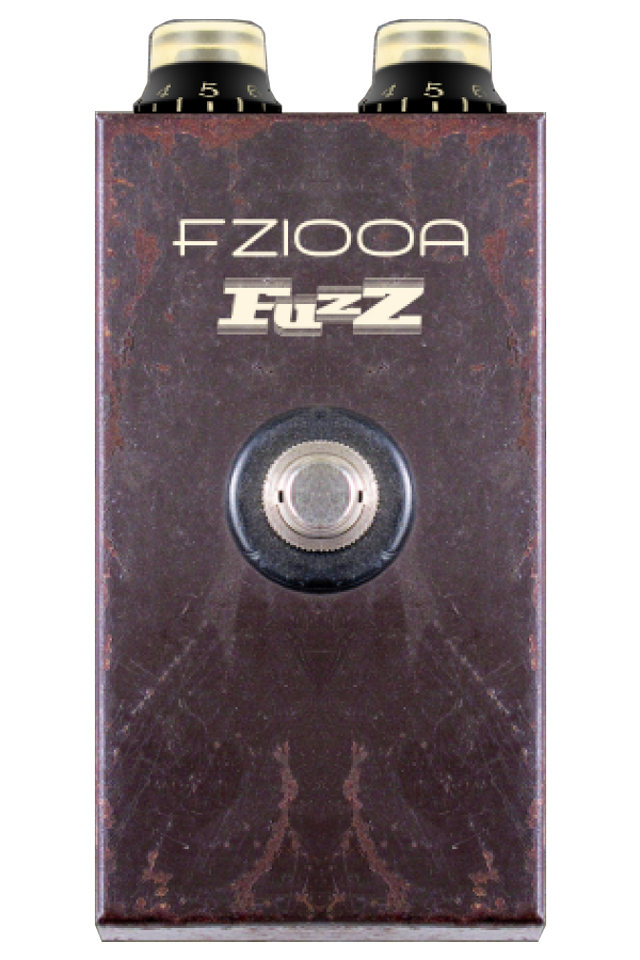
Hendrix was one of the handful of players that regularly used their volume knobs, even with the Fuzz Face engaged. It was like another version of a tone control, and you should be able to experience the same detail with this preset. Try rolling back the volume so that with the FZ102 Fuzz off, the guitar is relatively clean. Then, with the fuzz on, you should still get the same intense blast of energy even with the volume down, but the fuzz should now have more bass, a bit more hair. It’s a cool middle ground. Of course, when leads need to be ripped, you can push the volume to full blast and let your fingers dance across the fret board.
And so here it is. The latest iteration in our quest for Woodstock tone. We updated the preset switch for the PH100 Phaser to utilize the Cancel feature when off as opposed to true bypass. And we added a healthy amount of Cabinet Drive to push the guitar into sonic chaos. We left the expression pedal for the WH100 Wah, adding the ability to change the speed of the phaser via knob.
Preset: Woodstock VI
The sound finishes with the VG402C Amplifier, configured for ’69 topology, and the VG 4x12A 100W ’67 Cabinet for period correct tone. We think you’re going to really love jamming on this sound, we’ve found the combination of fuzz and phase shifting to be extremely inspirational, for both clean and heavily distorted tones. It’s no wonder that one of the most memorable live performances was created from this sound. Now it’s your turn.
It’s time to gear up for “Back to the Beginning,” Black Sabbath’s final concert planned for July 5th, 2025. Whether it was in the spirit of experimentation, or a desire to make each song distinct, Tony Iommi covered a lot of ground with each Black Sabbath record. This wasn’t just a case of setting up a few mics and running through the songs. With a mix of acoustic pieces and experimental passages for guitar, it’s clear the band’s vision was not just to be heavy, they wanted to take the listener on a journey. Join us as we walk through a brief history of Black Sabbath tone.
Don’t have AmpStamp yet? Download now and head to the Explore section to load the presets mentioned below!
Early Days: Copy of a Copy
In the late 60’s and early 70’s there weren’t that many options for guitar players when it came to tone. Marshall had borrowed from Fender and focused on improving the loudness of their amplifiers. Maestro debuted the Fuzz Tone in 1962, and once it became popular from a Rolling Stones hit single, many seized the opportunity to make their own version of fuzz. But if you didn’t like the sound of fuzz, guitarists had to turn it up to get the sound they were looking for–the concept of a master volume wouldn’t come until the mid 70’s. And when amps were turned up, they typically got flubby from too much bass, harsh from poorly designed power amps, or even broken due to speakers that couldn’t handle loud volumes for long periods of time.
Preset: Paranoid
Enter Paranoid, our take on the early sound of Black Sabbath. There is some photographic evidence of Iommi during the recording of Paranoid with a white SG and Laney and Vox amps.1 While it’s unclear where the Vox was used, early Laney amps were essentially copies of the first Marshall circuits, similar to the JTM45, if not the original Fender version which allegedly came from an RCA manual. These early designs were heavy in bass frequencies which created a market for treble boosters. Marshall eventually added more treble and reduced bass with their High Treble channel, later referred to as Channel I. However before that, a popular effect like the EQ100 Treble Boost would find it’s way on to several classic recordings.
With only one guitar, Iommi tended to double his parts and hard pan them left and right. With “Paranoid,” in particular, it sounds like there were different mic placements for each take. The left channel sounds more towards the center of the speaker, providing a brighter sound, and the right channel sounds more towards the edge of the speaker, providing a darker sound. We’ve mapped one of the toggle switches on the Floor Controller for easy access, aptly titled “Bite.” We also couldn’t help but include the RM100 Ring Modulator, featured during the solo in “Paranoid.” Add the WH100 Wah for tracks like “Electric Funeral”, and we think this is a really great snapshot of this early period in Black Sabbath tone history. Fire up the tritone, and let it rip.
Playing Notes: Paranoid
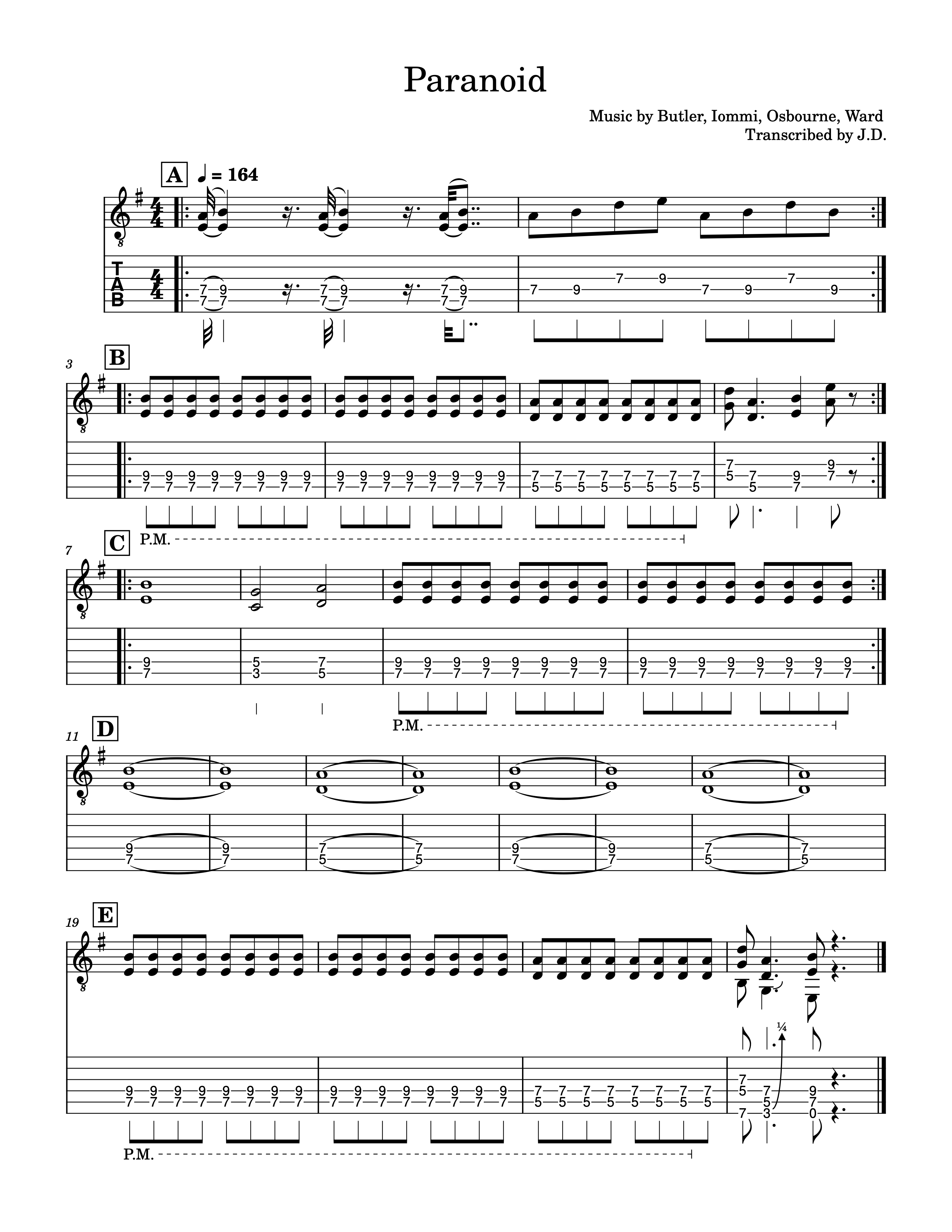
Something that I found interesting when taking a closer look at these classics is that my phrasing didn’t always line up with what Iommi was actually playing. It’s subtle, but take a moment and pay attention to his rhythmic style. For instance, there is a pause at the end of measure 6 in section B during the verse where I almost always add additional content to fill the empty space. It took a lot of concentration to leave that gap and then come in on the repeat with a palm-muted E power chord. I was adding accents there too! One additional note, in measure 2 of section A, Iommi lifts his fingers after each note for a staccato feel. I had previously barred the D and G strings on fret 7 which does not sound the same.
Playing Notes: Iron Man
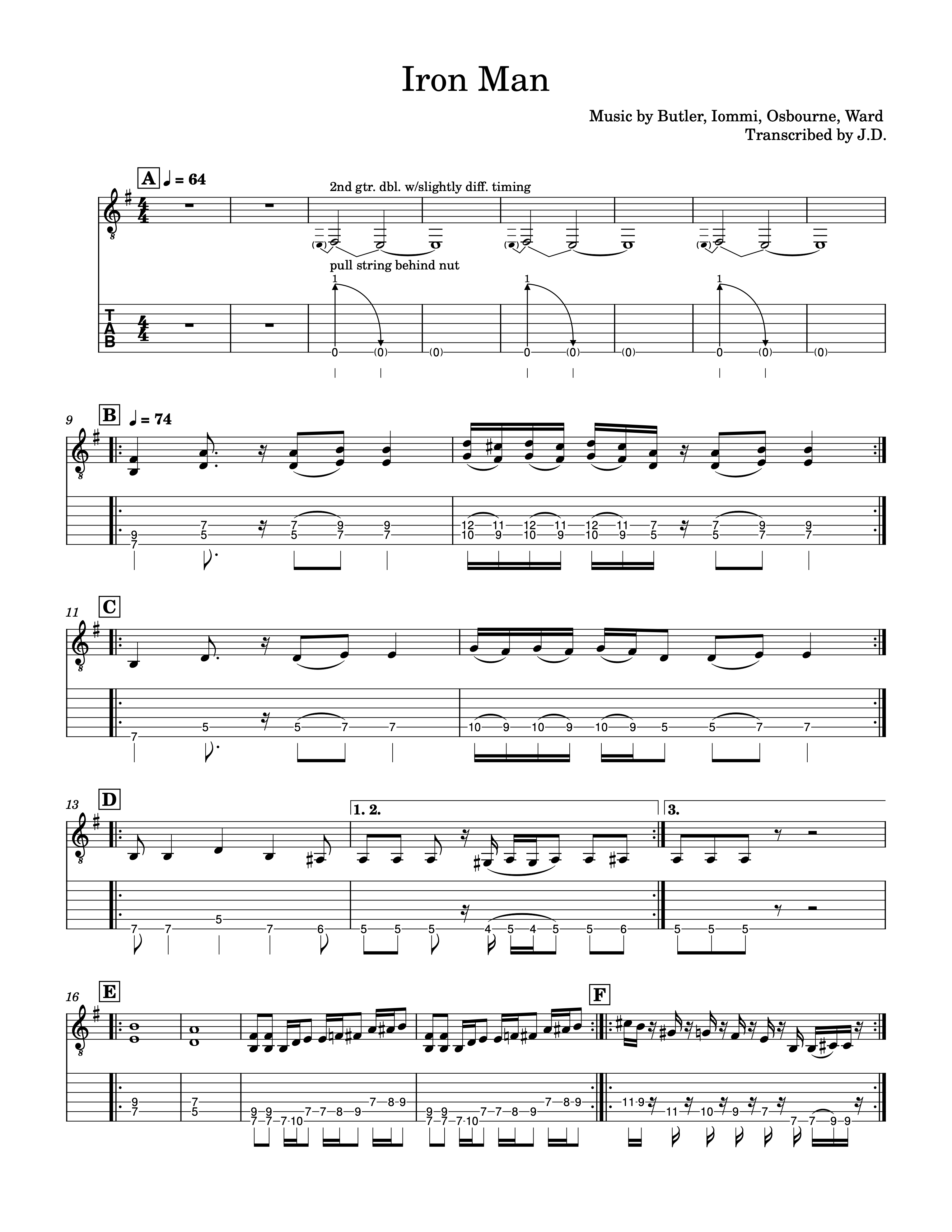
The riff that launched a thousand bands! Made even more famous by cartoon deadbeats Beavis and Butthead. When looking more closely at this song, there is a lot of restraint in Iommi’s playing. And the rhythm of the main phrase is peculiar. I was not sliding from the D to E power chords, opting to add more stops than are present in the recording–I seem to have a heavier rhythmic strumming style. It’s definitely a challenge to try and match a recorded performance. You can learn something about your own way of playing by trying to mimic others.
Master of Reality: A Bigger, Heavier Sound
“It was part of an experiment: tuning down together for a bigger, heavier sound.” – Tony Iommi2
With their third album, Iommi made some drastic changes. In retrospect, this might have been a response to the new term being used to describe their music–heavy metal. The question being, could the music get any heavier? After experimenting, Iommi settled on tuning his guitar down to C#, and increasing the Bass level on his amplifier for added …heaviness.
Presets: SweetLeaf II, SweetLead II, Master of Reality
We’ve seen claims that a Laney Klipp 100W amplifier was used on Master of Reality. Let us know if you have a link to a source where Iommi states as much. While this amplifier is still on our list to explore, we had some success combining the FZ102B Fuzz and the EQ100 Treble Booster which is a more traditional approach for this tone given the information we have. We also fine tuned the cabinet selection for better results. There is definitely something heavy about this tone. It has a chunkiness that you can really dig into with palm-muted power chords …turn on, tune down, and feel the heavy.
Playing Notes: Sweet Leaf
Another heavy riff from the master. And another riff where I was adding more when there should be less. The biggest difference was in the first measure/section A. I found it extremely difficult to pause between the first transition from the A to D power chords. I tend to want to add something during that eight note rest. In fact, you can sometimes hear a pick scrape from Iommi just prior to the D power chord which sounds like it’s from an up stroke getting ready to hit the next chord. There’s also a slur at the end of section A that isn’t always in time as we’ve notated, feel free to experiment when playing along with the record.
Vol. 4: A Touch of Brightness
On the next album, things are brighter. Possibly as a reaction to tuning lower and increasing Bass to try and make things heavier. Ultimately, the final mixes sounded too dark, the impact may not have been as intended. With Vol. 4, we hear new JBL speakers, the fuzz is out, but the lower tuning remains. It’s like a return to the early days, with monster riffs–possibly one of the best in the catalog.
Preset: Vol. 4
This is a fairly straightforward tone, back to basics. The brightness inherent in the 2×12″ C 100W ’68 Cabinet shines through and helps rhythm guitars cut, especially with lowered tunings.
Playing Notes: Supernaut
While a simple song, consisting of only two riffs, it’s certainly one of my favorites. Apparently, it was a favorite of Frank Zappa’s too.3 Regardless, this song is all about slipping and sliding on the fret board. It sounds like section A is played with one finger, either the index, or middle. Try using only one finger and sliding into the D, then slurring down to B, and back up to D. The song really came into focus once I realized that, and it’s fun to play! Not to mention the monster chorus riff. Make sure to note the difference in the last chord in section B before the repeat. It’s subtle but it helps the transition to the 7th chord both harmonically and physically based on economy of movement. And one more thing, pay close attention to measure 6 in section A, there’s a slide back down to E at the beginning of the measure that’s really hard to catch.
Commercial Excess
Iommi admitted in his autobiography that as the band grew more successful, things became more difficult. There were difficulties keeping the band focused, an eventual lawsuit with management over mismanaged funds, and no shortage of party favors to keep everyone going. Nonetheless, this didn’t stop Iommi from trying to keep things interesting with each new record. With Sabbath Bloody Sabbath and Sabotage, we continue to see experimentation between bright and dark passages (an acoustic chorus in a heavy metal song!?), new synthesizer sounds, all against a steady foundation of heavy riffs.
Presets: Sabbra Cadabra, S.B.S., Sabotage
With the next few albums, we hear a more compressed tone, similar to Alnico speakers from a Vox AC30. Being there is evidence that Vox amplifiers were in the studio during some early sessions, we queued up the 2×12″ C 30W ’67 Cabinet, however still using a classic Marshall head similar to the Laneys Iommi was using. The sound was impressive enough to share.
Playing Notes: Sabbra Cadabra
Watch out! This riff moves fast. It’s in 12/8 time, similar to 4/4 with quarter notes having a triplet feel. This is another great example of Iommi slipping and sliding on the fret board with economy of motion helping to maintain a faster tempo. In section A measures 1-2, I found it easiest to slide from E to G with the middle finger leaving the index finger free to grab the high E. Note, the initial slide from E to G is a hammer-on, not picked!
Playing Notes: Hole In the Sky
Another monster riff in 12/8. While the whole song is excellent, the best part has to be the power chord bends in section B. They sound so sinister.
Playing Notes: Sabbath Bloody Sabbath
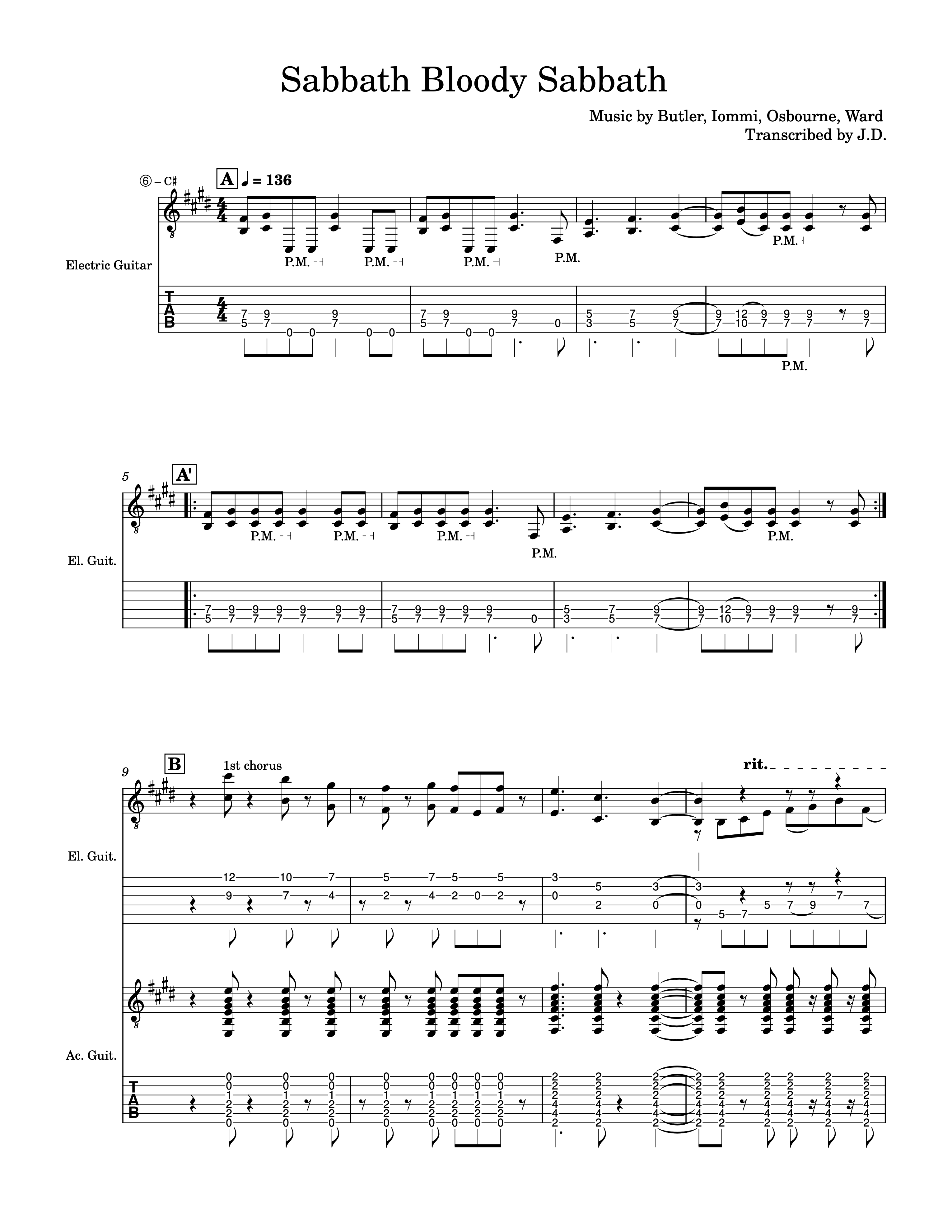
I saved “Sabbath Bloody Sabbath” for last. It’s one of Iommi’s magnum opuses that successfully combines softer elements that stand in contrast to the heavier parts. The transition to a gentle, acoustic chorus, then back to heavy electric guitar is extremely effective. This helps set the mood and especially strengthens the heaviness of the riff in section D. Note, I’ve transcribed embellishments from the first chorus only which are more or less similar to the second chorus, hopefully this helps provide a range to experiment with while playing along.
In today’s landscape, it goes without saying that heavy metal guitarists rely solely on preamp distortion, keeping master volumes low for tighter bass response, and use modern speakers like Vintage 30s for balanced tone. But imagine a world before all of this was in place. Heavy metal wasn’t a concept, just heavy music. The word heavy could apply to lyrics, tone, or image. Black Sabbath seemed to embody all three. Without a blueprint to follow, what else could heavy music have sounded like?
1 Grow, Kory. Liner Notes for Black Sabbath. Paranoid: Super Deluxe Edition. Warner Records Inc., 2016, p. 8.
2 Iommi, Tony, and T.J., Lammers. Iron Man: My Journey Through Heaven and Hell with Black Sabbath. Da Capo Press, 2011, p. 98.
3 Butler, Geezer. Into the Void: From Birth to Black Sabbath and Beyond. Deyst, 2023, p. 131.
If you haven’t been yet, I highly encourage a trip to the The Punk Rock Museum. It’s jam packed with memorabilia from all eras of punk. There’s an amazing list of tour guides from famous band members that helped shape what punk rock music is today. And there’s a bunch of other stuff to keep you occupied too. What really stood out to me, outside of getting to meet a hero of mine in the flesh, was the Jam Room. It’s a well maintained stockpile of real gear that bands used to play live and record with. And you can pick up and play these instruments too. Yes, you.
I’ve seen hands-on exhibits before. Where the artist wants you to interact with their installation, or being able to make your own art inspired by another artist’s work. But I don’t think I’ve ever seen an example of an artist giving you their tools for inspection, or to actually make your own art with. I immediately took advantage of the opportunity to play through a modded 1978 Marshall JMP 2203 MKII that belonged to Chett Lehrer of Wasted Youth, thanks Chett! I did not ask what mods were done on the amp, but it’s a master volume model and it was set up with the preamp gain cranked and the master volume slightly above bedroom practice level, just loud enough to fill your ears. There was a brightness that you could already hear would cut through a mix, but it wasn’t too harsh.
Sitting in a room and playing through a Marshall is something every guitar player needs to experience. There was obviously special significance with this one, it was one of the amps that inspired the music. This is exactly what the band heard back in the early 80’s, and what inspired countless songs that we consider punk rock gold today. And it goes on. The gear, the music, the personalities, the influences. It’s all right here. You can reach out and touch it. I played part of a song I wrote to see how it sounded through a piece of history. And it sounded great.
In 1978, Marshall was still stocking cabinets with 25W speakers from Celestion. It would be a few years before higher power experiments would pay off and the G12-65 would be introduced. It’s unclear why, despite being sold as a standard 25W speaker, Celestion was either forced to due to supply constraints, or decided to intentionally, change the speaker cone and the color of their magnet covers. The latter obviously has no impact on tone, but it does help with speaker dating. The result in 1978 was a “new” Celestion 25W speaker using an updated cone dubbed “Kurt Meuller” after the company who supplied them, with a black magnet cover as opposed to green. These new speakers were loud and in-your-face right out of the gate.
Preset: Fast n’ Loud
The aggressiveness of this speaker, the way it shapes the sound of a distorted guitar amp, played perfectly into the burgeoning style of music that would later be known as punk rock. Whether the music influenced the technology, or vice versa, or non of the above, it’s unclear. What is clear is that for a while, Marshalls saw new life in the punk rock scene. With this preset, we’ve assembled the core components of this sound in AmpStamp, and added some room resonance to put you in a similar space. While you should make the pilgrimage to hear this amp for yourself, now you can rock out any time you want, anywhere you want.
The Punk Rock Museum is a celebration of the history of punk rock, but it really feels like new history is being made. Taking part in documenting and sharing this history in a way that hasn’t been done before feels fresh, exciting, and certainly new. Is this really punk though? Who cares.
It’s safe to say that the guitar community has been trying to recreate Eddie Van Halen’s tone on Van Halen I since it’s debut in 1978. That’s over 46 years of detective work and speculation. If you’re a veteran, welcome… we’re not going to tell you anything that you didn’t already know. If you’re just getting started, counterintuitive as it may seem, this might not be the best place for you to begin. Regardless, we want to give you a chance to play through gear that actually sounds like that first record, a very specific tone not heard on later albums. In early interviews, Eddie hinted that he didn’t care for the sound of his guitar on that first record.1 In reality, it’s become one of the definitive sounds of rock guitar for many players, old and young, and though a mistake, immortalized as “The Brown Sound.”
The Magic Marshall
The main question on most people’s minds has always been, how did Eddie achieve such an extreme level of distortion out of a non-master volume Marshall? First on most lists is the Variac, used to reduce the voltage supplied to the amplifier, purportedly causing clipping at a lower volume. Next is setting the bias of the amplifier, some say high, while others say low because it might not have been adjusted post-Variac, and still some say it was correctly re-biased at the lower voltage level. Then it all gets mixed up, between EQ pedals and preamp boosts, specific brands of vacuum tubes, not to mention a resistive load placed on the output of the amplifier stressing the transformer to the point of destruction while simultaneously allowing the amplifier to be run at full tilt.
Did we capture any or all of this? No, of course not. But what we do have is an accurate model of a non-master volume Marshall that sounds like it should, with enough gain to spare. We’re of course referring to the 402C Amplifier.
The Speaker Blend
Once out of the amplifier, the next critical element is the speaker cabinet. In this case, and for many guitarists of this era, a blend of two or more speaker cabinets was used to create a distinctive tone that served as a sonic signature. Something that would be hard to duplicate and therefore set them apart on the airwaves. The predominant combination that most suggest is a blend of Celestion Greenbacks and JBL D120s. Of course, that still doesn’t narrow it down. No two speakers sound alike from the same lot, let alone those that were made years apart. And each speaker has a variety of incarnations. This was where our quest really slowed down, until now.
We managed to get a hold of a very particular speaker, the 2×12″ ’77 100W Cabinet, and when blended with the 4×12″ ’73 100W Cabinet, the whole definitely becomes greater than the sum of its parts. It was nothing short of magical when we first heard this combination of cabinets and speakers.
The Guitar
We also think it’s important to mention the guitar, because your guitar is probably not going to sound like ours. That’s one of the reasons why we make recordings, to ensure that you can hear what we hear regardless of the axe you’re using at home. And so in our case, we landed on a Strat with a beefy humbucker in the bridge position, straight not angled, with a modern two-point bridge. There is a thick quality to this tone that did not come through in the custom Frankenstrat builds that we attempted. Suffice to say, any normal Strat with a high-output humbucker in the bridge position is a reasonable starting point.
Everything Else
And that’s it really, the rest is history. We’ve got the EC101C Echo, EQ110 Ten Band Equalizer, PH103A Phaser, and FL101 Flanger to fill out the minor details. To our ear, the core tone is there. No need for fancy delays or reverbs, though we didn’t shy away from using the AMB 400 Plate Reverb. We think that once you strike your first A-chord, new portals will open up transporting you to tone nirvana. The chase is over, so… what are you waiting for?
1 Rosen, Steve. Tonechaser – Understanding Edward: My 26-year Journey with Edward Van Halen, Robert Smith/API Productions.com, 2022, p. 65, 75.
Slash is a self-proclaimed Marshall man. But what if–and this is the second time this has happened on our tone journey–what if we got down to comparing sounds it was just easier to get there with a Mesa Boogie? Less tweaks, no fuss, and the tone is just there.
The last time this happened was with the Ride the Lightning Tone, where all accounts pointed to a Marshall amp being used, but after hours of listening tests, again we just could not deny that it was easier to get closer with a Mesa amplifier… the Mark IIC+ of course. And it’s no different for this tone. But now, we have some evidence. Oh the evidence:
Diagram 1: Live Feedback Studio Setup1
Here it actually is. For the Use Your Illusion sessions, Slash, or more specifically Adam Day, his guitar tech, explained for Guitar Player how Slash used two amplifiers, one in the studio and one in the control room. The amp in the control room was intended to allow feedback to occur between the guitar and amplifier, something that could not happen if Slash was playing in a different room from his studio setup.
If you read between the lines, what we really think is happening is that the Marshall needed to be near full volume to achieve the best tone, without pedals, however the Mesa Boogie could be overdriven at lower volumes. It would make sense then that the Marshall would be in the studio, and the Mesa would accompany Slash in the control room for better separation, as well as to enable the aforementioned feedback. Additionally, since the Mesa could achieve good tone at lower volumes, the amount of desired feedback could be controlled by changing the master volume.
We think most of the tracking on these sessions used a blend of the Marshall and Mesa setups. In fact, it’s undeniable during listening tests. Why did Slash end up using a Mesa? Maybe Slash liked the sound of Izzy’s setup and wanted to try it out for himself, maybe they needed a second amp to experiment with live feedback and didn’t want to rent another one, or maybe Slash–who lost his favorite SIR Marshall from the first record–didn’t necessarily like the sound of the new one and wanted to spice things up. Who knows. But what we do know is that you now have this tone at your fingertips, so hot it’ll bring you right next door to hell.
Preset: Uzi
Though Diagram #1 mentions the Mark III, the VG802C Amplifier comes in extremely close, being only a few tweaks away. When run through the VG 4x12HBA 250W ’85 Cabinet blended with the VG 4x12A 100W ’67 Cabinet, the sound is unmistakable.
Preset: Uzi Lead
In order to get enough separation from the core tone, we dialed in to the VG 4x12HBA 250W ’85 Cabinet exclusively, you could also experiment with the other cabinet as well. We then added the AMB400 Plate Reverb to bring out your leads in the mix and voilà.
1Diagram 1. Slash’s Live Feedback Studio Setup. From “Welcome to the Equiment Jungle,” by Rick Eberly, 1991, December, Guitar Player, p. 44. Copyright 1991 by Guitar Player.
It’s no secret that R.E.M. were looking for something different during the recording of Monster. They had just come off of a run of very successful albums, but the band felt they were lacking in the rock department. Enter Monster. Peter Buck is not known as a guitarist that’s into lots of gear. Buck typically chooses to lay back on most tracks and serve the song. The best way to indulge in Buck’s playing is to focus on the chord voicing and rhythm, let the tone engulf your ears, and simply rock out. Monster is a perfect example of great vintage tone, with amps cranked and guitars strumming away, let’s take a look at some key components you’ll need to achieve this tone.
First and foremost, the amp. We think the amp used on this record was it’s centerpiece. It’s as if Buck decided to focus on one amp and explore all the sonic possibilities that this amp could provide, each track featuring a different facet of the amp–sometimes multiple. It’s been said that Buck played through Silvertones, Fender Twins, Vox AC30s, and Mesa Trem-o-verbs over the years1, all confirmed via live performances, but there’s not much information as to what went on in the studio. To our ears, we definitely hear an Alnico speaker which either indicates a Vox AC30 or potentially a Silvertone head into a Vox cabinet. For this, we’ve dialed in the VG302E Amplifier with the VG 2×12″ 30W ’67 Cabinet. But that’s not the full picture. There is a distinct mid-boost that is not present in most amplifier tone stacks. For now, we’re satisfied using the EQ106 Six-Band Equalizer. We’re running this into the Normal channel which is typically dull and bassy, but with the mid-boost, things brighten up and you can instantly hear Buck coming through your speakers as you strum those huge chords.
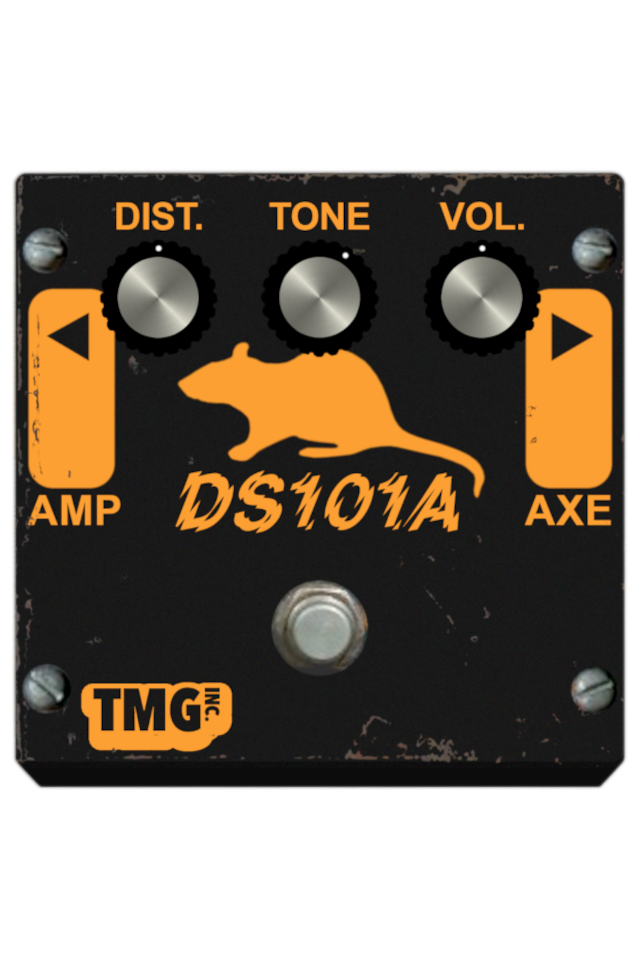
With the basic tone dialed in there are only two more elements, Tremolo, and lead tone. The Speed control for the Vibe-Trem channel on the VG302E Amplifier nearly perfectly matches some of the performances on Monster, in the Slow and Fast settings. It adds to the likelihood that Buck was using an AC30 all over this record. For lead tone, we know that Buck has been spotted with a ProCo RAT in his pedal board so we added the DS101A Distortion to cover all bases.
Preset: What Frequency?
This core tone is great for rocking out on massive chords, kicking in a lead tone for searing solos, and adding Tremolo when things need some movement.
Looking back, it’s surprising to think that anyone would want to stop Eddie Van Halen from making music in any way possible, but that was the case as we headed into a new decade in 1980. Eddie had established himself as the guitar player of a new era of hard rock, and no one in the group wanted to see him experiment with keyboards, especially their producer, Ted Templeman. Luckily for us, they let this first foray slip on the third album, and we were graced with an extremely gritty sound that to our ears could actually have been a guitar.
Taking a queue from the enormous guitar sound that he had crafted, Eddie ran a Wurlitzer keyboard into the same Marshall amps and effects that he used for guitar. The opening riff is played by banging both hands on a cluster of keys and engaging an MXR Flanger to produce an audible sweeping effect. We’ve recreated this setup with the VG402C Amplifier, 4x12B ’78 100W Cabinet, 4x12A ’67 100W Cabinet, and FL101 Flanger. To our ear, the open top end sounds like Eddie (or more likely Don Landee, the engineer responsible for capturing Eddie’s tone) was blending low-powered vintage speakers in the mix.1 Additionally, we hear more bass in this tone so we’re using Channel II. It really brings the chunk out in some of those power chords. We also added a separate preset for keyboard since gain and tone needed to be adjusted and tuned to work with keyboard input.
And the Cradle Will Rock… this is a true classic, and we think you’re going to love digging hard into this heavy metal masterpiece. With a plethora of pick scrapes, slides, trills, and a whole lot of whammy bar dives, there’s a lot of ground to cover!!
Preset: Romeo
The core tone. Tuned for guitar and ready to rock. With a thick bass and bright, open top end, your palm mutes will thump, power chords will rip, and solos will come screaming out of the speakers.
Preset: Wurly
Tuned for keyboards, specifically a Wurlitzer model. Slap on the flanger for that unmistakable sweep, and just grind out some triads for an amazing tone. It’ll sound like a guitar!!
It’s a controversial album for die hard fans. On one hand, it’s the beginning. The first taste of what would become one of the all time greatest metal bands, steeped in the thrash metal scene of San Francisco. On the other hand, the production suffered from a producer and engineer caught in the sound of the seventies. The mixes lack weight, the guitars are too thin, and the drums don’t push air like they should. But… you can hear the bass.
Still, it’s an album that deserves recognition. If not for being the first from Metallica, then for standing apart from the other thrash metal bands of the scene with tight, meticulously crafted songs. Vocals that rip right through your brain, searing leads, and some chunky rhythm guitar.
Let’s talk about the chunky rhythm guitar. It’s been said many times over that Hetfield used a Marshall and a RAT distortion pedal.1 Though we have been unable to find attribution of this information, we think this is spot on. But running a distortion pedal straight into a Marshall typically sounds terrible. At the time, it would most likely have been a master volume model, and one of the tricks for using distortion pedals with Marshalls–to be discovered time and again by several artists–is to plug into the Low Input. That’s right. Who ever uses the Low Input? Additionally, to our ear, Bass and Treble should be between 5-6, and Middle should be at 0. The first occasion of scooped mids?
Now for the pedal. The RAT distortion was capable of achieving massive levels of gain, but after some experimentation, we think this was dialed back, more like a boost on steroids. Just enough gain to create the chunk that you hear when playing palm muted power chords. And it sounds glorious.
We’ve queued up the VG402C Amplifier, 4x12B ’78 100W Cabinet, and the DS101 Distortion in three distinct flavors. Don’t forget to push the distortion as hard as you want. We think this is the perfect launch pad for achieving the tone from one of the most revered thrash metal albums!
Preset: Militia
Tweak the Edge to blend in more bite and recreate the classic left-to-right pan effect heard at the beginning of Metal Militia.
Preset: Horsemen
Next up is a tight crunch meant to satisfy fast palm muting. Crank the distortion and let heads fly.
Preset: Fire
For this preset, we attempted to get more gunk. You can hear every nuance when muting, engulfing you in it’s fiery tone. Great for solos.
1 Let us know if you have a source for this information!
In case you missed it, back in 2020, Jimmy Page went on record and described his setup for recording one of the most classic riffs of all time, “Whole Lotta Love.”1 Page spoke of taking advantage of an abandoned Vox Super Beatle head, plugged into one of his Rickenbacker Transatlantic cabinets. He doesn’t mention the specifics of either model, but it narrows things down. There was also a recent illustrated book which corroborates this statement, where we do in fact see Page in the studio with a Vox head sitting on top of a Transatlantic cabinet.2 Additionally, there is also some footage of Page describing the Tone Bender fuzz effect as having a massive influence on this recording.3
Combining the VG 302E Amplifier with the VG 4x12B 100W ’73 Cabinet, and adding the FZ101B Fuzz for just a little flavor, we were able to unlock that unmistakable zipper-like fuzz that Page achieved. We voiced the cabinet to capture more of the room, and added an alternate option for those looking to blend in some studio reverb. We think you’re really going to dig the results.
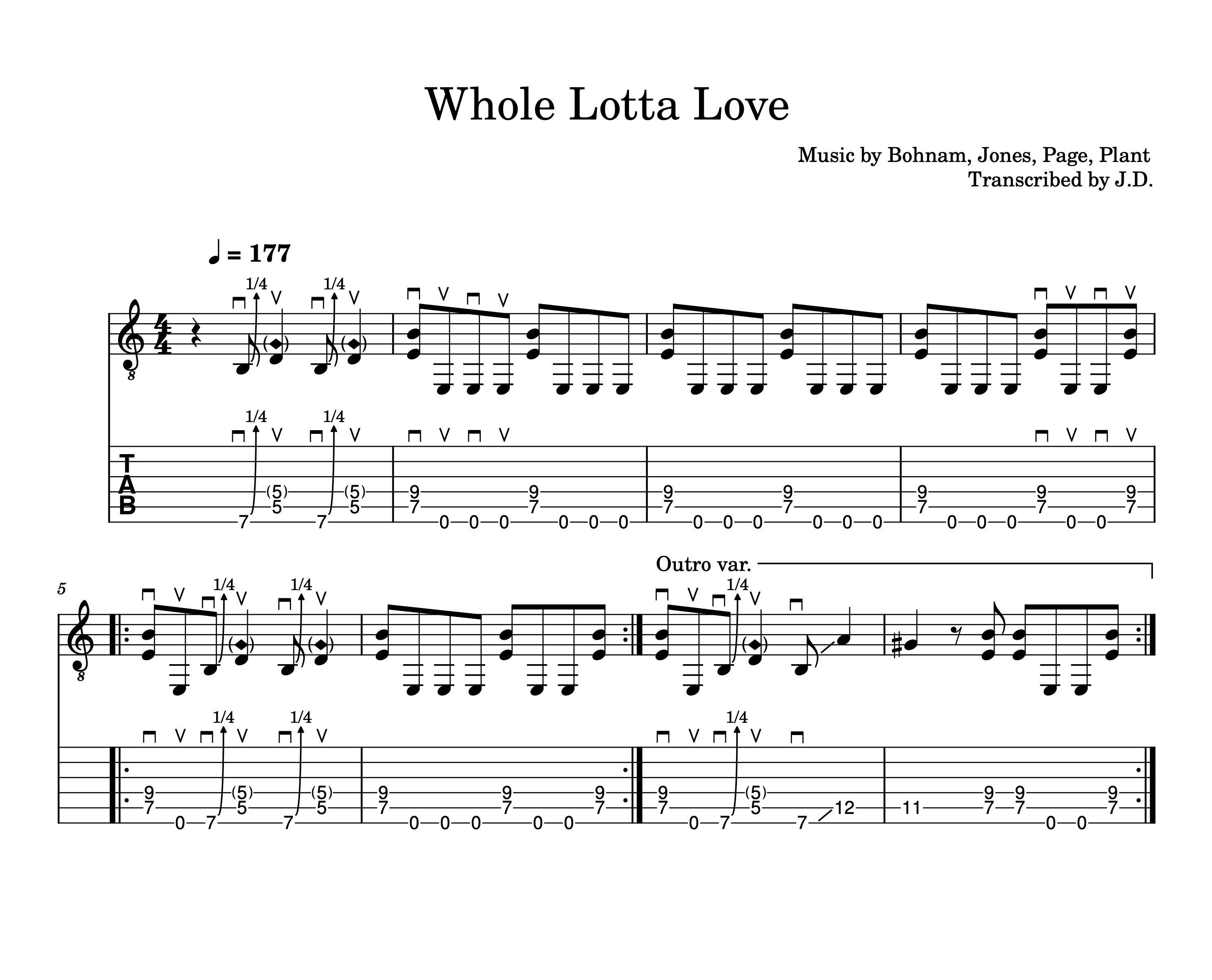
But things wouldn’t be complete without talking a little about how that riff was played. There’s a real groove to how Page strums, almost to the point of imperfection, all to maintain a loose feel. Here’s what the main riff looks like on paper, with the additional variation during the intro (it’s really fun to play).
There are a few things to take note of:
We’ve highlighted the strumming pattern to help inform how we think this riff was played. Page’s hand was essentially constantly strumming back and forth in rhythm, never stopping. This back and forth rhythm helps accent down strokes, as well as provides a deep, infectious groove. The track really swings.
Also note that Page bends B-notes (E-string, 7th fret) up on down-strokes. He pulls into the D-note (A-string, 5th fret), which creates a much more interesting feel than if we just play a straight B-note. It has a stronger push-pull rhythm.
Lastly, there is a harmonic that accompanies the D-note by letting your index finger connect with the D-string on the 5th fret. It’s further accentuated by playing this with an up-stroke. Since the harmonic is hit first with the pick, it’s very present in the mix.
Preset: Lotta Love
This is the core tone. A slight fuzz, more ambience, and the combination of a Vox amp with Celestion speakers. It’s unmistakable. To our ears, it’s a zipper-effect. The way the fuzz makes the guitar sound like a zipper is being pulled up, or down. So pull away!
Preset: Lotta Lead
Though potentially not accurate, we threw in an extra preset for lead that we used on the sample recording you hear. It’s a fun combination of an older fuzz with traditional Vox speakers. It certainly cuts through the mix. Enjoy!
And there you have it. One of the heaviest riffs ever recorded, right underneath your fingertips. Add some fuzz for a zipper-effect, get your picking hand into a steady groove, and hit those bends and harmonics to help this riff swagger. This song is a testament to artists who look for new sounds both with the equipment they use, but also on the fret board as well. Despite having just twelve notes, phrasing and articulation can be infinitely variable. Along with AmpStamp, the power is yours. Go forth and rock!
Recording electric guitar on this record was so complicated, producer Butch Vig has been quoted saying they needed a visual guitar map to keep track of all the different parts Corgan was dreaming up.1 Despite the layering needed to get closest to this tone, one thing is true, a heavy fuzz is a must. And AmpStamp delivers this in spades with the FZ104A Fuzz.
Also, after doing extensive tone tests, our ears have selected the VG302E Amplifier. Although this goes against most interviews, Vig has briefly mentioned his affinity for AC30s in the past2, and it seems possible that these combos could have been run into typical 4x12s that would be used with traditional Marshall heads. We’re also blending old and new cabs to bring out the best of both worlds. Check it out!
Preset: Cherub
Packed with a heavy fuzz, this tone is perfect for alternative rock à la 1991. Stack up separate left and right takes for an amazing stereo image. Ideally suited for a humbucker in the bridge position to help cut through the mud, anything will do really. And if you’re stuck with noisy single coils, engage the Squelch gate.
Preset: Cherub Lead
Changing Color for a darker tone and engaging the FL100 Flanger, new you can recreate blistering leads from this classic album. And when you reach post-production you can flip the Matrix switch and manually control the flange, just like the record. It doesn’t get much better than this!